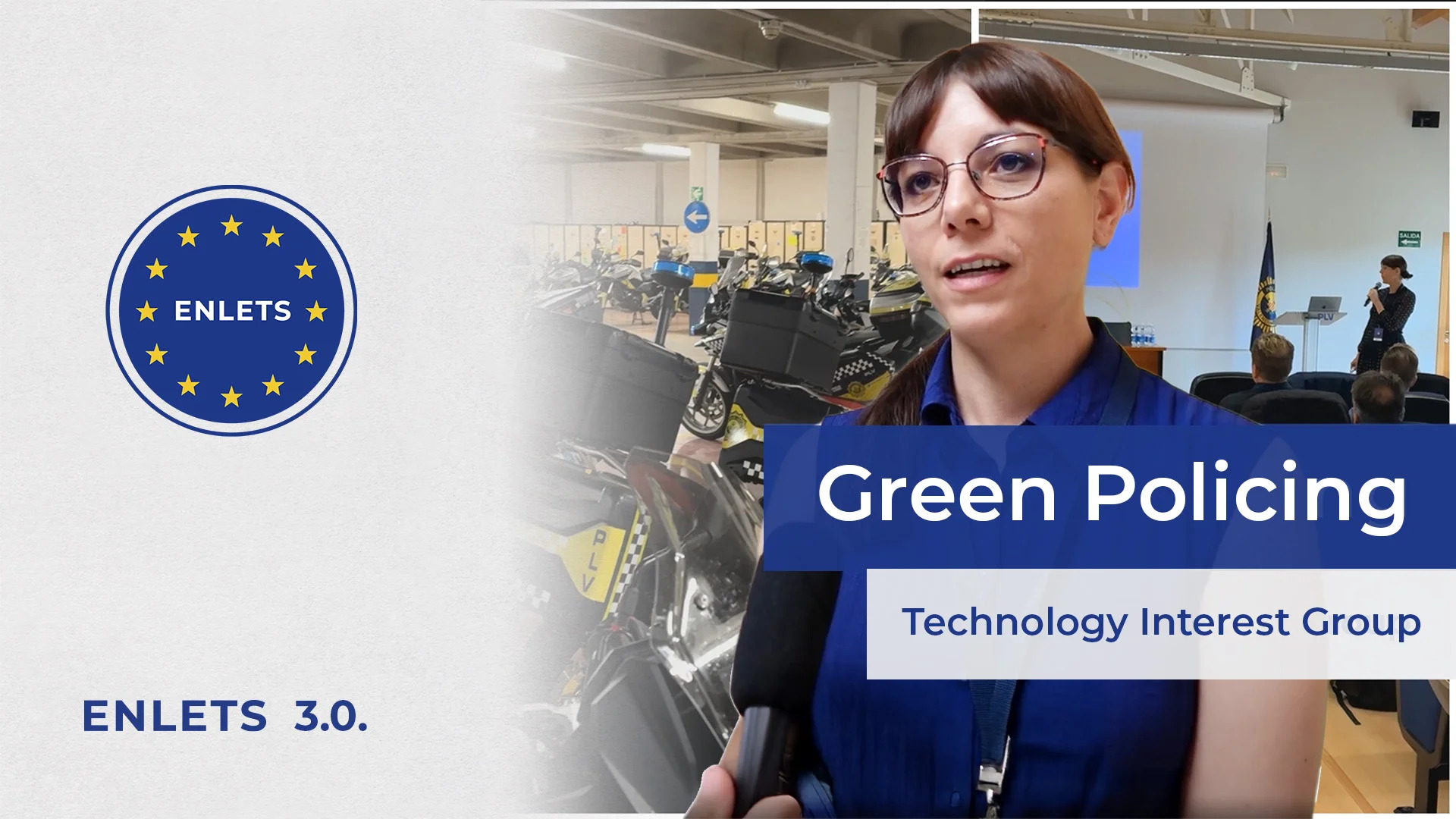
Environmental considerations are becoming an increasingly integral part of modern policing, shaping operational planning, infrastructure management and long-term capability development. Within ENLETS, collaboration between its Technology Interest Groups enables Member States to respond to such cross-cutting challenges in a coherent way. The Green Policing TIG contributes to this shared effort by examining how law enforcement can reduce its environmental impact while maintaining operational effectiveness, forming an important element of the current ENLETS 3.0 programme.
The group was established in recognition of the fact that police services operate large fleets, buildings, logistic and procurement that collectively create a significant environmental footprint. Climate change already affects daily policing through events such as flash floods, wildfires,severe storms and blackouts, while the European Green Deal commits the EU to climate neutrality by 2050 with interim targets for 2030 and further objectives for 2040 under development. Against this backdrop, the TIG explores how realistic adjustments in policing can support wider sustainability goals. Its work is organised around three complementary areas — Green Mobility, Green Buildings and Green Ways of Working. Regular online meetings serve as the main mechanism for ensuring accountability and progress across the group’s three subdomains.
As part of ENLETS 3.0, the Green Policing TIG is focusing on deliverables that support evidence-based planning and provide a clearer understanding of how different countries are progressing. A central output is the Green Policing Handbook, which will map national approaches to decarbonisation and sustainability and highlight both effective examples and practices that have proven less successful. This shared analysis is intended to help agencies avoid repeating earlier mistakes, reduce unnecessary expenditure and identify realistic starting points for future actions.
Another key element of the group’s work is the development of common criteria for sustainable policing. These criteria are designed to provide a shared point of reference for areas such as procurement, infrastructure planning and organisational processes, helping to build greater consistency across Member States. The aim is to offer practical guidance that agencies can adapt to their own circumstances, rather than imposing uniform solutions.
Through these activities, the Green Policing TIG contributes to the broader aims of ENLETS 3.0 by promoting a more coherent European approach to sustainability within law enforcement. Its work supports the integration of environmental considerations into policing in a consistent and credible way across Europe.
Contact ENLETS to contribute to sustainable change in policing through the work of TIG Green Policing.