An EU-funded project running from the 1st May 2019 to October 31 2022.
Police officers are typically the first emergency personnel to arrive at a scene of a high-risk or crisis situation. Emergency preparedness is vital in such cases. Oftentimes, police officers are forced to make decisions in dangerous, high-stakes situations with ambiguous information under severe time constraints.
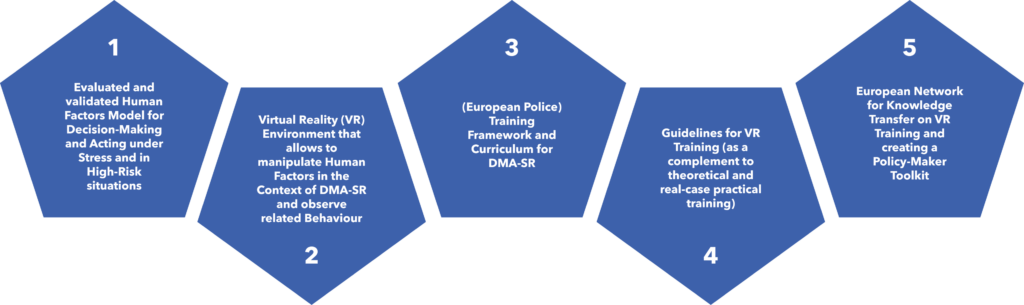
SHOTPROS project aims to investigate the influence of psychological and contextual human factors (HFs) on the behaviour of decision-making and acting (DMA) of police officers under stress and in high-risk operational situations to design better training for police officers to improve DMA Performance. SHOTPROS will develop a Virtual Reality (VR) solution to experimentally assess the degree to which these factors influence DMA behaviour.
Subsequently, the project will develop a Human Factor rooted training curriculum and a corresponding VR training solution to provide a comprehensive framework for practical training for decision-making and acting under stress and in high-risk (DMA-SR) situations in order to improve performance. The training will increase DMA-SR performance, which will lead to better decision-making.
Existing trainings mainly focus on skill training and do leave out the decision-making and acting behaviour training. We aim to set up a training framework, enhanced with Virtual Reality, to change the training methods in LEAs to come to better decisions and minimizing use of forces, collateral damages and escalations.
Markus Murtinger, Coordinator of SHOTPROS
https://shotpros.eu/
The SHOTPROS project is funded by the European Union’s Horizon 2020 research and innovation Programme under grant agreement No 833672.
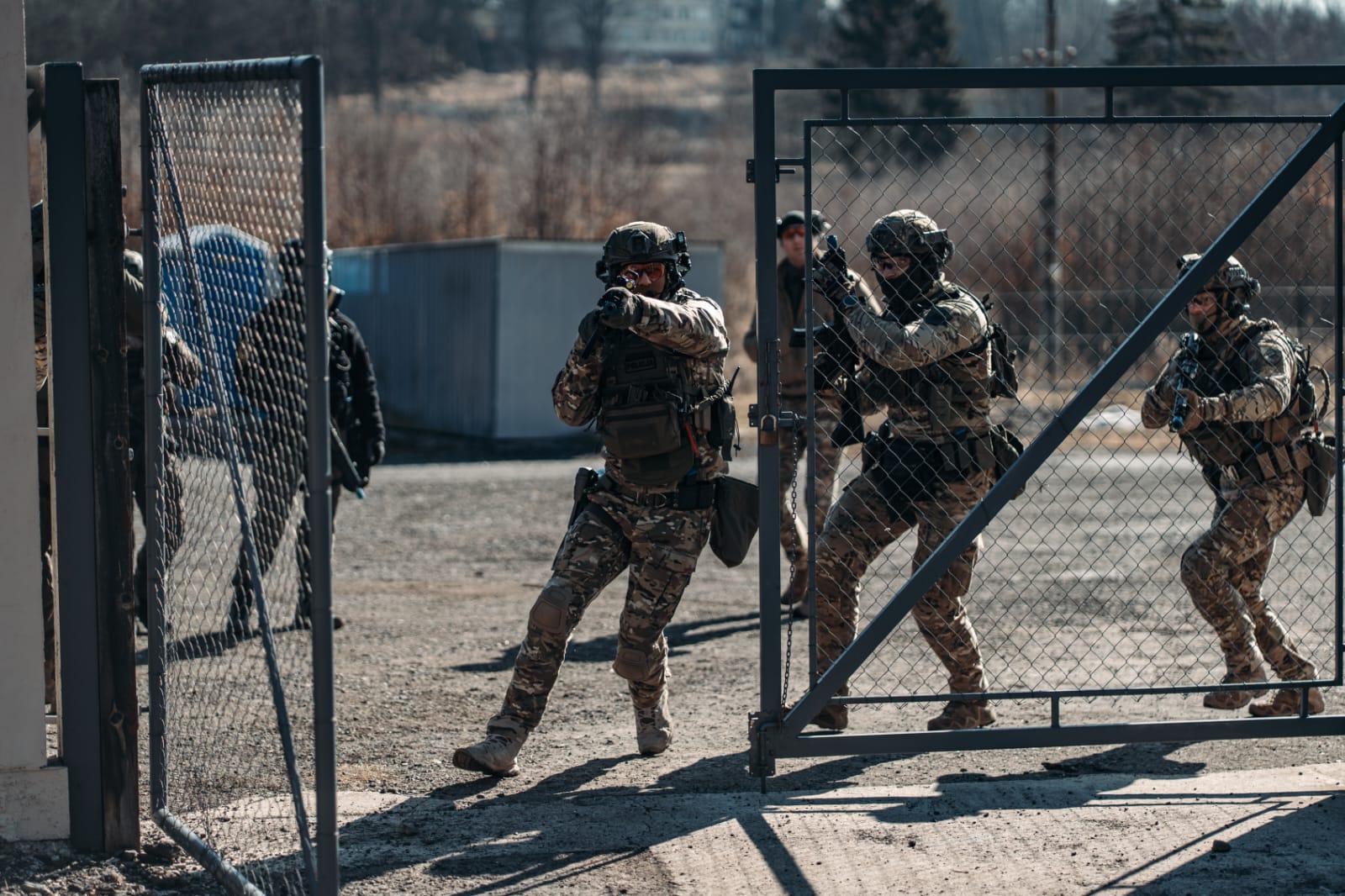
Counter-terrorism officers from the Mazovia region (Poland) took part in a joint operational training in Slovakia. The officers were invited by the Special Police Unit PPÚ Bratislava and trained together at the Lešť Training Centre in Slovakia from 23 to 27 February 2026, enhancing cross-border cooperation and operational readiness. This initiative directly resulted from ENLETS collaboration, demonstrating how international partnerships can be translated into practical actions.
The new ProtectEU strategy marks the beginning of a new era, in which Member States strengthen their capabilities to protect societies and democracies. This includes enhanced threat assessments, greater use of EU-developed technologies, and stronger operational cooperation between police forces across Europe.